An England v. Sweden game, three years ago:
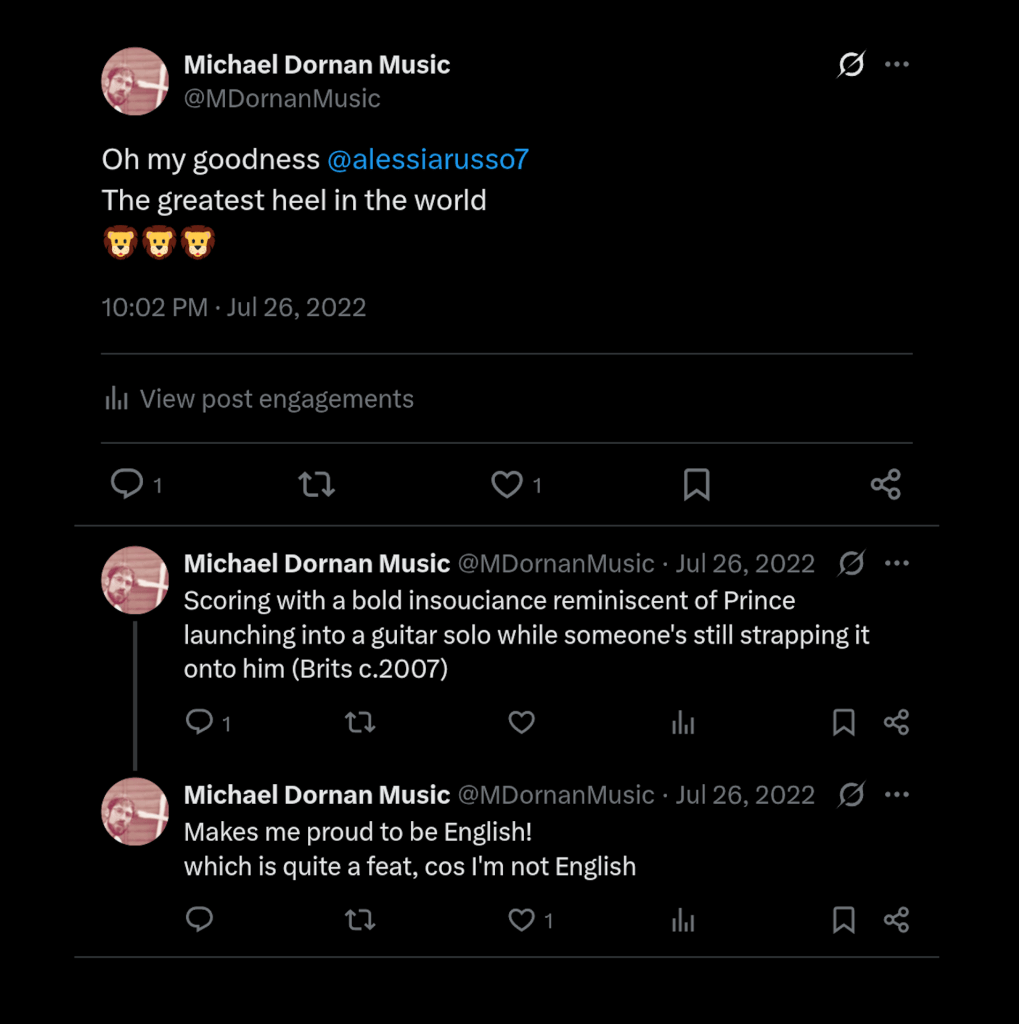
You might have heard of this audacious backheel. Or watched it on a loop, heard it mythologised. A friend had tipped us off just a few days earlier: “Have you been watching the women’s Euros? It’s something else…” We had to admit that no, we hadn’t been paying attention. Well, better late than never, and once we tuned in, the team spirit, the unpredictability and positivity of what we saw was infectious. So much so that I’ve been increasingly interested in a sport that had lost its charms for me somewhere in the mid-2000s.
The Lionesses have put in plenty of praiseworthy performances since, but fast-forward to a night in the 2025 tournament that pitted them against the same opponents, and they made me proud to be ‘English’ once more.

Sweden had been massive this tournament. Forward-thinking, undermining even the stronger defences with their power, speed (and height), it was expected that they’d present England with their sternest challenge thus far. And so it was, when a rather shaky starting line-up for the Lionesses gave the Swedes more chances than they needed. One-nil up in the 2nd minute of play courtesy of their captain – by the 25th, the redoubtable Stina Blackstenius raced past a trailing England defence to make it two. Those in the blue away kit of Sweden were a well-drilled unit – those wearing three lions, a collection of great individuals. Like a holidaymaker aboard who’s brushed up on their vocabulary, but in situ, the syntax and pronunciation fail them.
And so the score remained, half-time showing a two-goal deficit that wasn’t insurmountable, but even with England’s return to the pitch, an unchanged formation that didn’t offer much promise. The deficit remained – I admit that at the hour mark, I went to make a cup of tea. By 70, the team I support, yes, the ones that dragged me back into caring about this whole sport again, were due to be beaten – at least the better team will have won. Nothing seemed to be at stake. Sigh of acceptance along with my decaf Earl Grey.At least the substitutions showed a bit of spirit – Esme Morgan ran onto the grass with a note to pass around about tactics, ready to bolster the back-line; teenage striker Michelle Agyemang could give Sweden’s back-line problems and change the tempo; Beth Mead, golden ball winner in 2022, would have plenty to offer. So it proved, Agyemang’s contribution most evident at first, thanks to her fearlessness… and at least Sarina Wiegman’s England were giving it some effort, a very forward-thinking line-up taking shape as Chloe Kelly was subbed on at 78 minutes. Kelly immediately turned it around, with the kind of confidence that impressed in 2022 – as in the endlessly rewatched moment mentioned above, Russo had identified a narrow angle and converted it into a goal with the kind of backheel found on the training ground, Kelly trotted onto the field as if the 34,000 in the stadium weren’t there, as if the 7.4 million watching on the BBC weren’t chanting/despairing/consoling themselves with tea, and seemingly decided to send fast, elegant crosses into the box until one changed the scoreline.
On the other end of such a cross: another player who doesn’t accept reality as it is. I mean, as a professional female footballer, why would you? Reality as it was, when Lucy Bronze first wanted to play football, said no girls allowed. And members of this team have had to question such barriers, to find a way, to make opportunities, prove themselves. As a right-back, she often seems to reject the reality of being a defender and fly alarmingly high up the pitch. When a ball was sent in, lovely trajectory from Kelly, the furthest forward was a tireless Bronze, whose header into the back of the net was as probably more forceful than I could muster with my feet. Goal. Some might say she ‘manifested’ it – I think more of how she’s spoken of her autism and ADHD, how her hyper-focus is a real benefit to a footballer’s mindset. The focus was on getting England back into the game, and at 2-1 it didn’t seem outlandish to think she’d succeeded.
Boom. The crosses kept coming from Kelly, and with the whole team seemingly having turned into a Dad’s Army arrow, all direction and attack, someone got themself into the right position to put the ball across the line. Within a couple of minutes of Bronze scoring on her 138th senior cap, Agyemang scored in her 30th minute of senior gameplay for England. Anyone who saw her debut wouldn’t be surprised, as 41 seconds after coming on for a losing side, she turned a stunning volley into a stunning goal against Belgium, a glimmer of hope from a 3-0 disappointment, and without celebration urged her team to go again. This time, there was celebration, her face jubilant, and the hope was greater than a glimmer. Suddenly extra-time was a possibility, the Lionesses’ tournament might not end here.

Something was at stake again. It wasn’t going to be the que sera sera learning experience I’d envisaged, and the tension was palpable. Before our brace of goals, Sweden had subbed off both their captain and striker Rolfo – what a chance. Extra time came, it rolled on and as long as we stayed strong, as long as nothing happened to our slightly more confident-looking defence we were in with a shout, I thought – at which point to deny Sweden a winner from the air, our entire defence seemed to collide with itself, leaving keeper Hannah Hampton with her nose bloodied, Alex Greenwood on the ground and Bronze in discomfort. My stomach lurched. Seeing Greenwood like this reminded me of the concussion she sustained in 2023, when a clash of heads left her unconscious, medics attending to her within seconds, about 13 minutes of stoppage and a stretcher to take her away. Thankfully this time she was ready to continue. Second snapshot of Bronze’s heroism tonight: the medics are clearly focusing on patching her team-mates up, so Bronze grabs the bandages and wraps her stricken leg up herself. No half-measures here – it looked tight enough to cut off all circulation. And the bleeding Hampton was plugged up to everyone’s satisfaction, later resulting in the immortal headline “I’m better with one nostril”.
There were further knocks – captain Leah Williamson picked up a minor ankle injury and had to leave the game after a mere 106 minutes of gruelling exertion. Once a tired England had successfully held a tired Sweden to 2-2 after extra time, the penalty shoot-out that resulted was a gruelling watch, too.
I’ll spare you a blow-by-blow account, but neither side presented a penalty-taking masterclass. Sheer fatigue and immense pressure may have been factors. In the end, coming in for most praise were our mono-nostrilled goalie, and Bronze in tonight’s third heroic snapshot: taking a decisive shot in sudden death after best-of-five hadn’t yielded a victor. 103 kilometres per hour, or thereabouts. Absolute smasher, testing the strength of the netting. As acting captain, before converting she’d issued an instruction to her goalkeeper: “I’ll score this, you save the next one – game over”.
In another instance of bending reality, that’s exactly what happened. Having saved two in normal time, Hampton saved two in the shootout, and with her last touch, England were through. Okay, I can’t offer you incisive footballing analysis, but I can tell you what effect it had on a couple of fans after the tea had been exchanged for popcorn. A Chloe Kelly-esque celebration was only fitting, with a shirt to throw away in disbelief and joy. What we had seen was, in one sense ridiculous, so had to be matched ridiculously. We watch for amazing football, we watch for goals that give thousands of travelling supporters cause to cheer, we watch for the control and almost supernatural calm with which Lauren James runs rings around the world’s best players. But when such skilled legends are kept quiet by the other side, we watch for resilient characters hoping for a performance to be proud of even if the results don’t go our way. This time, when I had given up hope, the players hadn’t.
In a sense, people that get called heroes are carriers of hope. The tale stranger rescued by a normal passer-by from a freak accident, may restore some hope in decency and public spirit. The main character of a dramatic film, having swept you through a narrative and involved you in their fictional life, may give you hope that, should adversity strike, you’d show some heroism yourself. What is hope in the realm of sport? Where the stakes are not life and death, where the storylines are not shaped by some authorial hand, but something more unpredictable and akin to entertainment? It may be merely hope in victory. That we’ll have silverware to celebrate in a few days’ time, that we’ll be known as the best.
Let’s enlarge that ‘we’ for a moment – many years and several ability levels away from hoping to emulate the skills of anyone on the pitch, I imagine younger fans who watch a performance like this. Whether they dream of professional sporting careers, or simply want to play the game they love at a grassroots level (and thanks to the Lionesses of 2022, UK girls have equal access to football in PE at school), this kind of showing might stick in their minds. Their heroes are not Hollywood pristine, nor do they have the assurance of narrative closure; they do not fearlessly throw themselves in front of a careering snowplough in order to save a child. But when carriers of hope are themselves exhausted, bruised, subject to nosebleeds, when they may even be disappointed with recent performance, when they’re strapping their own limbs because the doctor’s busy, they offer an aspirational model not only to be pondered in moments of exhilaration and victory, but in moments of hardship and failure.
The afflicted hero can look like different things. In another dramatic quarter-final that went to penalties, another team somehow withstood and withstood, annoying their opposition with the odds overcome. In several accounts, Ann-Katrin Berger is mentioned as having twice overcome thyroid cancer – which is presumably meant to cast her as a survivor, to indicate strength of character and remind us that our heroes are as fallible as the rest of us. Germany, down to ten players in the 13th minute after a red card, somehow held off the feted French team’s attack, lasting through nearly 120 minutes until an own goal looked to be their undoing. A German defender having intended a clearance, her touch sent the ball high into the air above goal, but its arc quickly showed a misjudgement. While at least one French player lifted their arms in celebration, Berger fixed her eyes on the ball, began to run backwards, no chance to check where her own goal line was, leapt up and to her left, stretching her six-foot frame into the air, and with no room for a punch, scooped the ball off the line with her fingers, and landed heavily on her shoulder having saved her national team from a whimper after 100 minutes of sheer resolve.
That image of Berger at full stretch, echoing the elongated Amazon arrow on the ad hoarding behind her, was enough to induce amazement, whatever one’s allegiance. Never mind that in the subsequent penalty shoot-out she made two crucial saves and scored one herself! Berger deserves a statue, possibly recreating that pose in which she kept her country in the running once more.

The BBC ident for Euro 2025 bears the tagline ‘Names will be made’, which encapsulates both the handmade nature of their stop-motion animated video, and the tournament’s ability to catapult players into stardom. Though we should beware of exalting individuals, and wary of isolating them from their teams (witness every player in every interview deflecting personal adulation and reminding the press conference that they have their country to honour and their squad to thank), the ident must be considered a success. For the concept, for the fact that it’s fun, and for their choice of individuals:
Wales captain Jess Fishlock is there, who after filming became the first Welshwoman to score in a Euros final. The animation even captures the style of her run, that used to burn up half the length of the pitch and provide an assist against England in Wales’ final game. Spain’s Aitana Bonmati is present, her ability to outfox defences while staying composed and in control being depicted as literally tying her opposition side in knots. Although her tournament minutes have been reduced after being hospitalised with viral meningitis, she’s at her best, Player of the Match in their quarter-final against hosts Switzerland. Then in their full clay-moulded glory, we have Bronze and Berger – the former going in for a sliding tackle with little thought of self-preservation, the latter making her goal as impregnable as the vault of a Swiss bank. Whatever you think of the strategy of highlighting individuals, they seem to have backed the right players; whoever you support, many thousands more will know these people, and have sampled their excellence, after the Euros are over. And heroes or no heroes, sporting victory or no sporting victory, look at the statistics and be heartened. Poland qualified for a major tournament for the first time; the level of expectation on them doing so was so low that Nike didn’t bother designing a new kit for them, in contrast to the 15 other teams. They won a game and didn’t finish fourth in their very challenging group, as had been expected. But their coach said “our biggest responsibility at our first Euros… [was] get[ting]… girls interested in the sport”. Well, pre-tournament their highest domestic viewing figures for a women’s game was 600,000; their opening game, two million tuned in. And during the match in which they gained their three points, a Polish commentator advertised a website set up by their FA, designed to help girls find teams they can play for. That night, “[t]here was such a rush to the website,” writes sports journalist Joanna Wisniowska, “the server broke down”.

 Culture Me Up